Will an E-Bike Fit in Your Home? A Measuring Checklist
Gescoot Team
October 31, 2026
6 min read
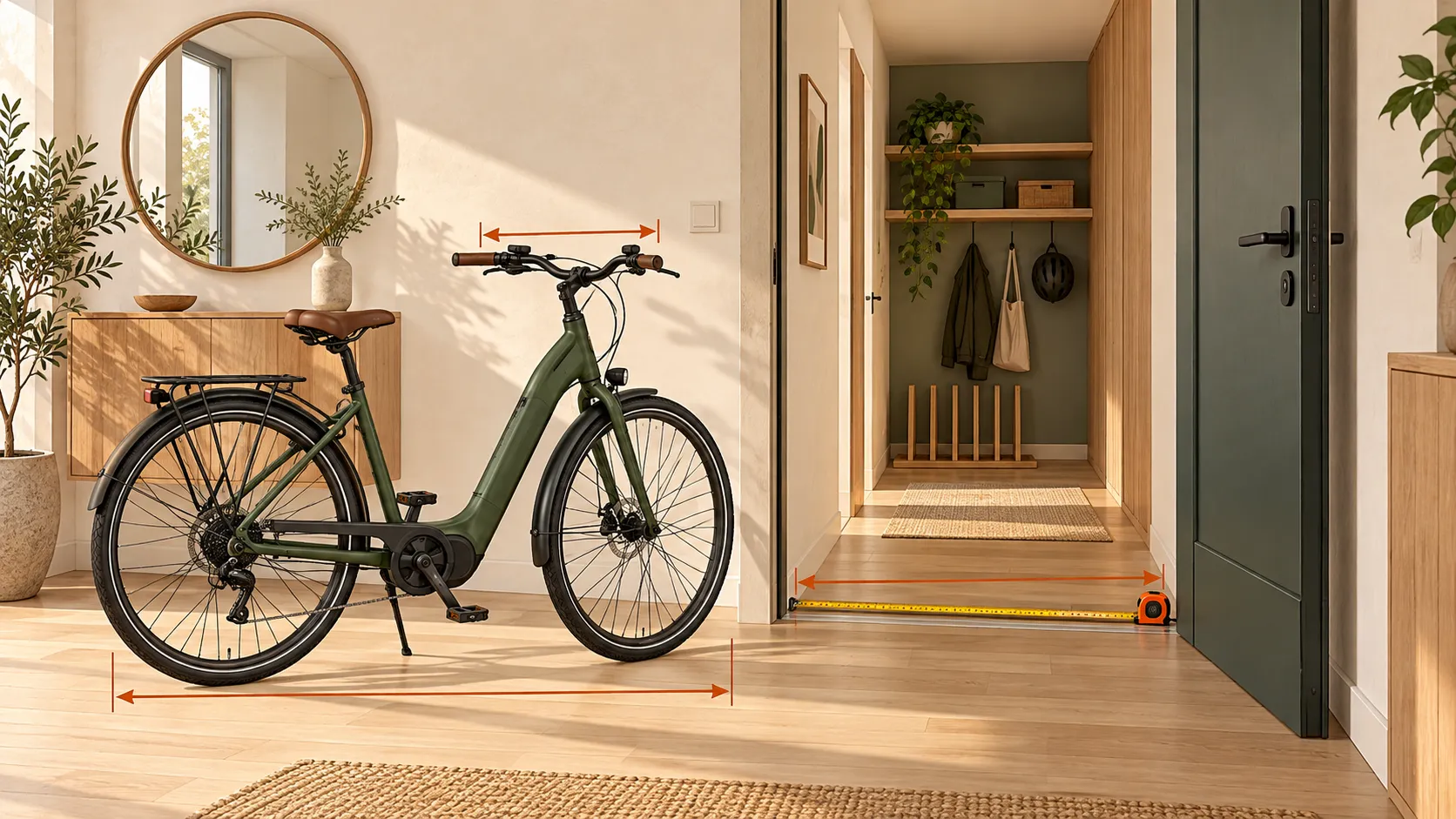
Editorial illustration; check the dimensions of your exact bike and home.
A spare corner can look perfect for an e-bike until you try to turn the handlebars through the doorway. Before comparing motors and batteries, check the less exciting part of ownership: getting the bike from outside to its everyday parking spot.
You need a tape measure, masking tape and a few notes on your phone. The aim is to answer three questions: Can the bike get in, can it park there, and can you get it out without rearranging the room?
At a glance
Check the whole route: doorways, tight turns, thresholds and elevators.
Measure the exact bike: overall length, maximum width and its intended storage configuration.
Test everyday access: leave room to stand beside the bike and guide it back out.
The key question: A bike that fits in a corner still needs to get through every doorway on the way there.
1. Measure the route, not just the room
Walk the exact route you would use after a ride. Include the entrance, any shared doors, corridors, elevator and the final turn into your storage area.
At each doorway, measure the clear opening with the door in its usual open position. Measure between the actual obstructions, rather than across the outside of the frame. Door handles, shoe racks and furniture can make the usable gap narrower than it first appears.
Write down these details:
The narrowest clear doorway or passage.
Any tight corner immediately before or after a door.
Raised thresholds or steps where you would need to lift the bike.
Doors you must hold open while moving through.
Objects that cannot conveniently move, such as a fixed cabinet.
Handlebar width is a useful first comparison, but a narrow doorway followed by a sharp turn needs more attention. The bike's length, steering movement and your own position all affect whether the maneuver works. A width measurement alone cannot confirm it.
2. Collect the right bike dimensions
Look up the exact model, frame size and configuration you are considering. Product photographs and wheel size are not substitutes for overall measurements.
What to check
Why it matters
Overall length
Determines how much space the bike needs from front to back
Maximum width
Captures handlebars or accessories that may catch on entrances
Height in the storage configuration
Helps check shelves, cupboards and low spaces
Folded length, width and height
Shows whether a folding model fits the actual opening and cavity
Complete bike weight
Helps you assess any unavoidable lifting
Do not substitute wheelbase for overall length: wheelbase measures between the wheel axles, not the outer ends of the bike. Similarly, a shipping-carton measurement describes the package, not necessarily an assembled bike.
Include the accessories you intend to leave fitted. A basket, mirror, child seat or panniers may change the space needed. If dimensions are missing or unclear, request confirmation for that configuration before ordering.
3. Mark out the parking footprint
Use removable masking tape to mark the bike's approximate length and maximum width on the floor. Treat this rectangle as an initial screening tool, not a precise outline: a bicycle has an irregular shape, and its position on a kickstand can change its footprint.
Now test the room around it. Can you open nearby cupboards? Can someone walk past without brushing the bike? Is there space to stand beside it and guide it back out?
Worked example — a close fit is not a confirmed fit: Imagine a storage recess 190 cm long and a bike 180 cm long. Those hypothetical measurements leave only 10 cm in total along that axis. They do not prove a comfortable fit, especially if you must turn the bike into the recess or reach around it.
Before you commit: There is no single spare-clearance figure that guarantees every setup will work. Where the fit is close, arrange a physical fit check if possible rather than relying on arithmetic alone.
4. Check the elevator and the last turn
For an elevator, record both the clear door opening and the usable interior width and depth. Handrails or other protrusions may reduce the space inside. You also need room to accompany and control the bike.
A cabin's diagonal length can suggest a possible position, but it does not establish that the bike can turn through the entrance into that position. Check the approach outside the elevator and the exit on your floor, too.
If your route includes lifting, consider the complete bike's weight and where the manufacturer permits you to hold it. A compact footprint does not automatically mean comfortable carrying. Keep this separate from the space calculation: a bike can fit on paper yet be awkward to move every day.
5. Check what “folding” actually changes
Compare all three folded dimensions with your storage space. A shorter folded bike may still be too wide for a cupboard opening. Brompton's folding-bike buyer's guide specifically highlights folded size as a consideration for storage at home and elsewhere.
Check the folding instructions as well. Where will you stand to fold it, and will accessories need removing? Leave room for that process outside the final parking spot.
Only plan on upright storage when the manufacturer supports that exact configuration. Tern's Vektron storage guidance, for example, distinguishes supported storage when fully folded from vertical parking while unfolded, which it does not permit. Do not assume another bike with a rear rack can stand on it.
Your final pre-purchase checklist
Before choosing an e-bike on Gescoot, keep these five items together:
Access route: Your narrowest opening and tightest turn.
Parking space: The usable length, width and height.
Bike dimensions: The exact model’s assembled or folded measurements.
Daily handling: Accessories and lifting steps that affect the fit.
Final confirmation: Any unanswered measurements to check before purchase.
Choose a setup you can repeat comfortably after an ordinary ride. Easy access is worth checking as carefully as the bike's riding specifications.
Frequently asked questions
How much space do I need to store an e-bike?
Start with the exact bike's overall dimensions in its intended storage position, then check room for access and maneuvering. There is no universal footprint that fits every e-bike and home layout.
Will turning the handlebars help it fit through a doorway?
It may help with a particular opening, but it changes the bike's position and steering angle. Check the approach and space beyond the doorway rather than assuming handlebar rotation solves the whole route.
Is a folding e-bike always the best choice for a small home?
Not necessarily. Compare its folded dimensions, weight and folding routine with your space. An unfolded bike that rolls straight into a convenient corner may be easier to live with than one you must fold and lift daily.